A worldwide stamp identifier combines visual clues, watermark checks, and the right catalogue system to pin down an unfamiliar stamp's country and exact issue.
Quick answer
A worldwide stamp identifier combines a photo-identification app with checks on script, currency, and watermark to narrow down a stamp's country before you look up its catalogue number in Scott, Stanley Gibbons, or Michel.
Key takeaways
- Check script, currency, and national emblems first to narrow a stamp's country of origin
- Scott, Stanley Gibbons, and Michel catalogues number the same stamp differently
- UK stamps are the only ones allowed to omit a country name, a legacy of the Penny Black
- A photo-identification app narrows candidates fast, but watermark and perforation confirm the exact issue
- Catalogue stamps by country and catalogue number so a mixed collection stays searchable
A worldwide stamp identifier is any method, app, or reference that narrows down an unfamiliar stamp's country, issue, and catalogue number without you already knowing where it came from. The fastest results come from combining a photo-identification app with a quick manual check of script, currency, and watermark.
What makes a stamp hard to place when it could be from anywhere?
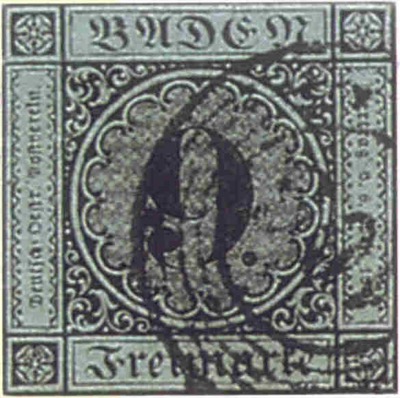
Most stamps give away their country in plain text, but plenty don't. Older issues used country names that no longer exist on a modern map. Colonial-era stamps were overprinted for territories that have since changed hands or changed names entirely. Some stamps carry only a monarch's portrait, a national symbol, or a currency figure with no written country name at all.
Script adds another layer of difficulty. A collector who reads Latin letters easily can be stumped by Cyrillic, Arabic, or Chinese characters on a stamp that would otherwise be simple to place. Without a starting point, sorting a mixed box of worldwide stamps can feel like guesswork rather than research.
What visual clues narrow down the country first?
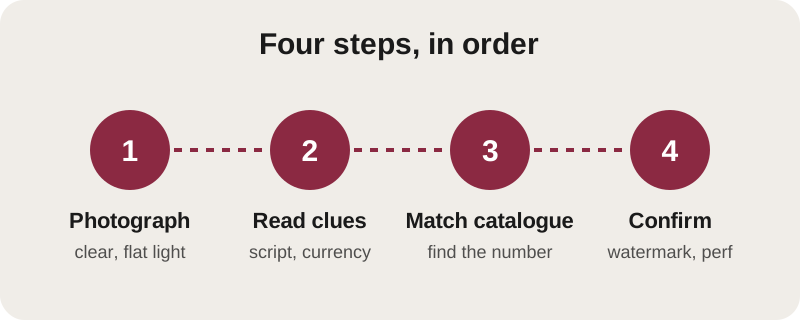
Before reaching for any tool, look at four things on the stamp itself: the script or language used, the currency unit shown, any portrait or national emblem, and the general printing style of the era.
Under postal convention, UK stamps are the only issues permitted to omit a country name entirely, a privilege granted because Britain issued the first adhesive postage stamp. Any other stamp without visible text is hiding its country in a small coat of arms, a crown, or an initial somewhere in the design. For a closer look at how to read these clues systematically, see our guide to identifying a stamp's country of origin and the companion piece on identifying rare stamps by country.
Which catalogue system should you use once you know the country?
Once you have a candidate country, you still need a catalogue number to search further, buy supplies, or compare condition notes with other collectors. The three major worldwide catalogues are Scott, Stanley Gibbons, and Michel, and they rarely agree on numbering.
| Catalogue | Strongest coverage | Good to know |
|---|---|---|
| Scott | Broad worldwide coverage | Widely used reference in the United States |
| Stanley Gibbons | British Commonwealth | Deep historical detail on empire and colonial issues |
| Michel | Germany and continental Europe | Preferred reference across much of mainland Europe |
A stamp from the same sheet can have three different reference numbers depending on which catalogue you open. That is not an error; it reflects three separate numbering projects built for different audiences. If you are starting from scratch, our guide to finding a Scott catalog online for free is a practical place to begin.
How does an app identify a stamp from any country?
A photo-based identification app works by comparing the image you capture against a large reference set of known issues, matching on design, colour, layout, and any visible text. The app narrows a worldwide search down to a short list of likely candidates almost instantly, which is the main advantage over flipping through printed catalogues page by page.
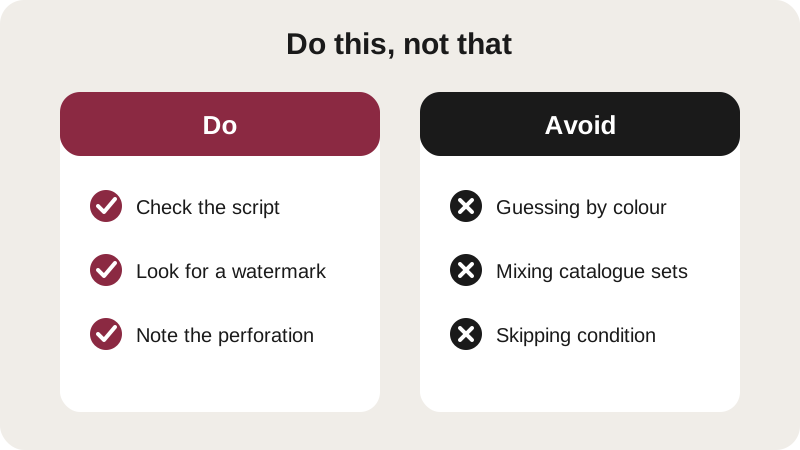
What an app cannot do is replace the final confirmation step. Two stamps from the same country and the same year can look nearly identical but differ in watermark, perforation, or plate number, and those differences are exactly what separate a common printing from a scarce variety. Our guide to the AI stamp identifier walks through how the matching process works in more detail, and the piece on stamp scanners covers how to photograph a stamp so the match is accurate on the first try.
How do you catalogue stamps from many different countries?
Once a stamp is identified, record it the same way every time: country, catalogue number, condition, and whether it is MNH or MH. Consistency is what makes a worldwide collection searchable years from now, long after you have forgotten which box a particular stamp came from.
- Sort by country first: keep a stockbook section or album page per country so new finds have an obvious home
- Note the catalogue and number together: write "Scott" or "Michel" next to the number, never the number alone
- Record condition honestly: centering, gum state, and any faults matter as much as identification does
- Protect as you go: a glassine envelope is fine for short-term sorting, but move confirmed stamps into a hingeless album for long-term storage
- Handle with stamp tongs: bare fingers leave oils that affect both appearance and future grading
Famous examples show why precise identification matters even when the stamp looks plain at first glance. The British Guiana 1c magenta is a modest-looking stamp that only reveals its significance once correctly identified and traced to its specific printing. Most worldwide collections will never hold anything that rare, but the identification habits are the same regardless of scale: check the clues, confirm with a catalogue, and record what you find consistently. For a deeper look at grading once a stamp is identified, see our guide on stamp condition ratings.
How does a worldwide stamp identifier know what country a stamp is from?
It works through elimination: script and language narrow the region, the currency denomination narrows the country, and design style narrows the era. A photo-identification app speeds this up by matching your image against known issues, but you still confirm the result against a catalogue entry.
What do I do if a stamp has no country name printed on it anywhere?
Check whether it carries a monarch's head and no text at all. Under postal convention, UK stamps are the only issues permitted to omit a country name, a privilege dating back to the Penny Black. Any other unlabelled stamp usually hides its origin in a small national emblem or coat of arms instead.
Why do Scott, Stanley Gibbons, and Michel give different numbers for the same stamp?
Each catalogue was built by a different publisher with its own sequencing logic: Scott organizes by country and date for a global audience, Stanley Gibbons has deep British Commonwealth coverage, and Michel focuses heavily on German and European issues. The physical stamp doesn't change, only which reference book you're citing.
Can a stamp identifier app replace a printed catalogue?
An app is excellent for narrowing a worldwide stamp down to a short list of candidates in seconds. You still need a catalogue, or the catalogue number the app surfaces, to confirm the specific plate, watermark, or perforation variety and to record it accurately in your collection.
How should I organize a collection that spans many different countries?
Group stamps by country first, then by catalogue number within each country, using a stockbook for unsorted material and a hingeless album for finished pages. Write the Scott or Michel number next to each stamp so the collection stays searchable years later.