Practical, time-efficient stamp collecting tips that let small business owners identify, catalogue, and store a stamp collection in short breaks instead of long sessions.
Published
Quick answer
The best stamp collecting tips for small business owners build short, repeatable routines: identify and catalogue each stamp before filing it, store the collection away from heat and coffee, and use spare minutes for scanning rather than long sorting sessions.
Key takeaways
- Catalogue each stamp the moment you get it, using Scott, Michel, or Stanley Gibbons numbers for quick reference later.
- Short five-minute sessions beat rare long ones — identify, sleeve, and log before moving on to the next task.
- Keep the collection in a stockbook or hingeless album, away from a coffee station, printer heat, or a sunny window.
- A themed collection tied to your trade keeps acquisitions focused instead of random and unmanageable.
- Write the catalogue number in pencil on the glassine envelope so identification never has to happen twice.
These stamp collecting tips for small business owners are built around short, unpredictable blocks of time rather than long weekend sessions. The goal is to identify, catalogue, and store each stamp correctly the first time, so a five-minute break never turns into a disorganized pile you have to redo later.
Why does stamp collecting fit a small business owner's schedule?
Running a small business means your free minutes arrive in fragments: between customers, during a slow hour, or while waiting on a supplier call. Stamp collecting adapts well to that pattern because each core task — identifying a stamp, writing down its catalogue number, sleeving it — takes only a minute or two on its own.
The habit that fails most busy collectors isn't lack of interest, it's lack of structure. If every session starts with "where did I leave off," you lose more time hunting for the last stamp than you spend actually looking at it. A short, repeatable routine solves that, and it's worth reading a general beginner's guide to stamp collecting once, so the basic habits are in place before you try to speed them up.
How should you organize a stamp collection between customers and tasks?
Treat every stamp the same way, every time, regardless of how little time you have. A fixed routine means you never have to think about what step comes next.
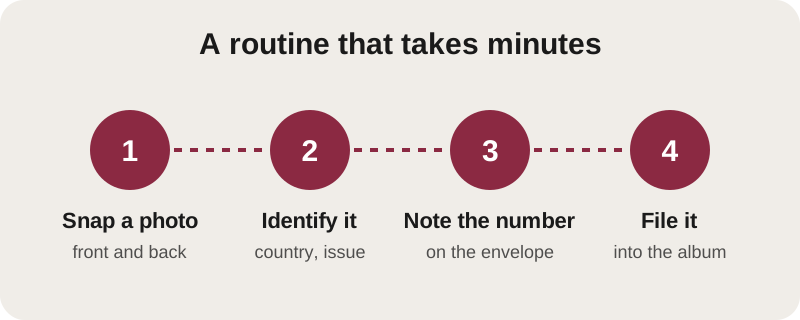
Keep a glassine envelope and a pencil within reach so a stamp that arrives mid-task can be noted and set aside safely, rather than left loose on the desk where it can get creased or stained. Write the catalogue number — Scott, Michel, or Stanley Gibbons, whichever system you use — directly on the envelope so you never have to re-identify the same stamp twice.
- One holding spot: a single tray or drawer for "not yet processed" stamps, so nothing gets mixed into business paperwork
- One album per source: inherited stamps, trades, and new finds stay separate until you decide where they belong long-term
- A running log: even a simple notebook entry with date, country, and catalogue number saves a lot of re-checking later
What's the fastest way to identify a stamp during a short break?
Start with what's printed on the stamp: the country name, the denomination, and the language used. Most stamps name their country somewhere on the design, and that alone narrows the search considerably before you open a catalogue.
Save the slower checks — watermark under a UV lamp, exact centering, gum condition — for a longer block of time, like after closing. Trying to do a full condition grading pass in the ninety seconds between phone calls usually means rushing it and getting it wrong. A quick, correct country-and-issue identification now is worth more than a rushed grade.
How do you store a growing collection in a small office?
Office environments are tougher on stamps than most people expect. Heat from equipment, direct sun through a storefront window, and the humidity swings near a coffee station or kettle all speed up damage that's invisible until it's already done.
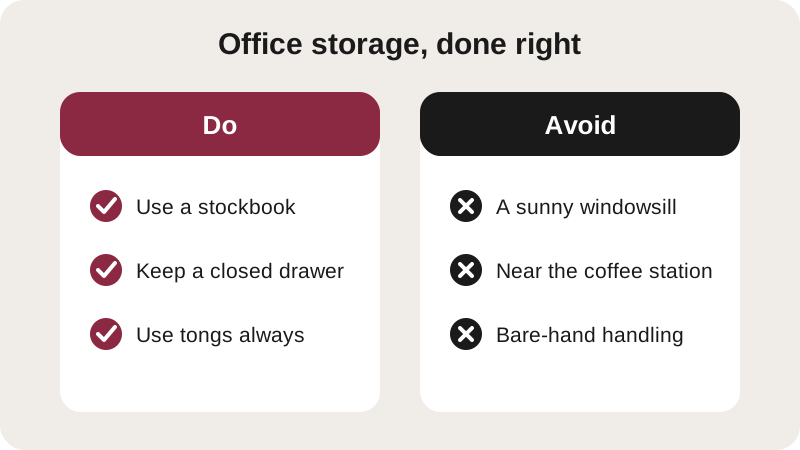
A stockbook is the most practical option for a working office: it's compact, holds loose stamps securely in glassine or plastic strips, and doesn't require the gummed hinges that can damage a stamp if removed carelessly. If you're ready to move stamps into permanent pages, a hingeless album with stamp mounts avoids that risk entirely, and it's worth reading a full storage and preservation guide before deciding which system suits your space.
Is it worth building a themed collection around your business?
A themed, or thematic, collection gives every spare minute a clear target instead of a vague "stamps in general" search. If your trade touches aviation, shipping, trains, or a particular craft, there's usually a well-documented set of stamps built around it, and chasing a narrower theme makes each find feel purposeful rather than random.
Starting pages exist for several popular themes, including aviation and trains and railways, and the broader thematic collecting guide explains how to pick a theme that will hold your interest for years rather than weeks.
How can you speed up identification without cutting corners?
The slowest part of collecting on a tight schedule is usually identification, not filing. A stamp with an unfamiliar script, an overprint, or a design you don't recognize can send you down a long catalogue search right when you have the least time to spare.
A photo-based identification tool shortens that step considerably. Take a clear photo during a quiet moment, and let it suggest the country of origin, approximate year, and likely catalogue numbers while you move on to the next task; you can confirm the details later. Pairing that quick check with the full stamp identification guide on slower days, and occasionally practicing with a postage stamp scanner, keeps your collection accurate without demanding long, uninterrupted sessions you don't have.
Stamp collecting doesn't need to compete with running a business for your attention. With a fixed routine, the right storage, and quick identification for the busy moments, it fits neatly into the gaps a small business day already leaves behind.
How much time does stamp collecting really take each day?
Very little, if the routine is set up correctly. Most small business owners manage stamp collecting in five to fifteen minutes a day: identifying one or two stamps, writing down the catalogue number, and sleeving them before the next customer or call arrives.
What's the quickest way to identify a stamp between tasks?
Photograph the stamp, check the country name and language on the design, and compare it against a catalogue or the app. Save the full watermark and perforation check for a longer session later — a quick ID is enough to file it correctly for now.
Where should a small business owner store a stamp collection at work?
Use a stockbook or hingeless album kept in a drawer away from windows, heat vents, and any coffee or printer station. Humidity and temperature swings do more damage to stamps than almost anything else in an office.
Should I collect general stamps or build a themed collection?
A themed collection tied to your trade or personal interest, such as aviation or trains, gives every spare minute a clear purpose. It narrows what you're looking for, which matters most when collecting time is limited.
Do I need expensive tools to start collecting while running a business?
No. Stamp tongs, a few glassine envelopes, a stockbook, and a basic catalogue are enough to start. A hingeless album and mounts can come later once you know which stamps or themes you actually want to keep collecting.