Stamp collecting tips for content creators cover safe on-camera handling, accurate identification with catalogue numbers, and storage that holds up between filming sessions.
Published
Quick answer
Stamp collecting tips for content creators center on handling stamps with tongs instead of fingers, confirming catalogue numbers and condition before filming, and storing stamps properly between takes.
Key takeaways
- Always handle stamps with stamp tongs on camera, never bare fingers.
- Note catalogue numbers (Scott, Michel, Stanley Gibbons) before you start recording.
- Keep studio lights cool and indirect so heat does not affect gum or paper.
- Store stamps in glassine envelopes or a stockbook between takes, not loose on a table.
- Batch-film by theme using one album section so cataloguing stays consistent across episodes.
These stamp collecting tips for content creators focus on three things a camera makes obvious: clean handling, accurate identification, and storage that survives being opened and closed for every episode.
What matters most when filming a stamp collection?
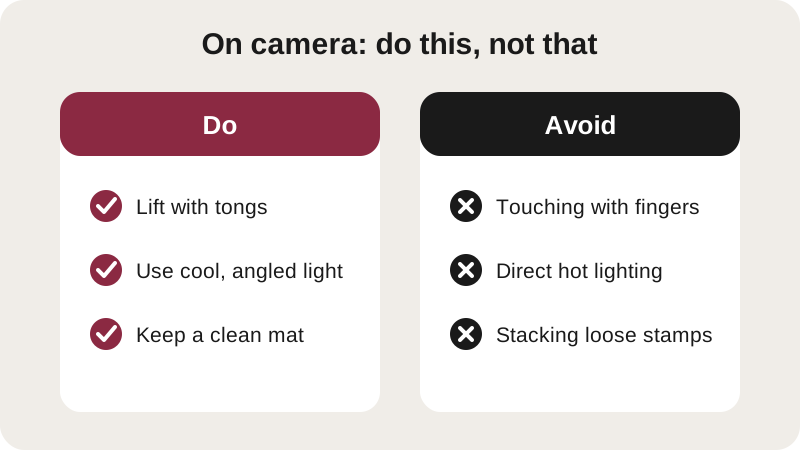
A macro lens shows every fingerprint, every smudge, and every stray crease, so on-camera stamp handling has to be stricter than casual handling. Work over a soft, clean surface, keep stamps in a glassine envelope until the moment you place them on camera, and lift each one with stamp tongs rather than your fingers.
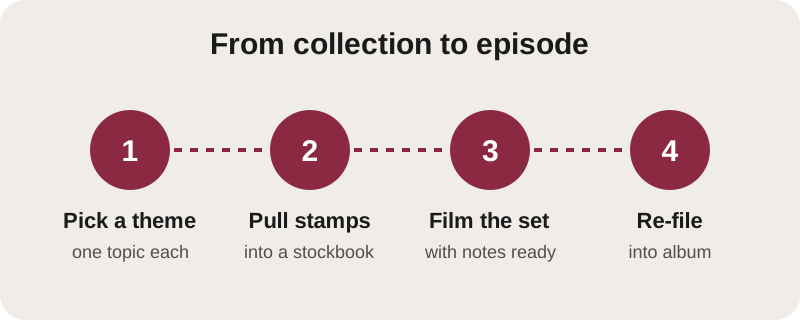
Beyond handling, think about pacing. Viewers lose interest if you spend minutes hunting for a stamp mid-recording. Pre-sort the stamps you plan to show into a dedicated stockbook page before you start, so the physical workflow on camera matches the story you're telling. This kind of preparation also protects the stamps themselves: less time spent searching through loose material means fewer accidental touches, fewer dropped stamps, and less time spent with a stamp exposed to warm studio lights before you actually need it in frame.
How do you keep identification accurate while recording?
Separate identification from presentation. Figure out the country, issue date, and catalogue number of each stamp beforehand, then narrate from those notes instead of trying to work it out live in front of the camera.
- Scan or photograph the stamp to confirm country and approximate year of issue before you film.
- Check the watermark and centering under good light, away from the camera's heat.
- Cross-reference the catalogue number against Scott, Michel, or Stanley Gibbons, whichever your audience expects.
- Write a one-line note on condition and mount status (MNH or MH) to read from on camera.
This sequence keeps your on-camera commentary accurate without turning the recording into a research session. If you cover different countries across episodes, a general guide to identifying a stamp's country of origin is worth keeping bookmarked for quick checks between takes. It is also worth building a simple running document of stamps you have already identified, so returning viewers can see your collection grow episode by episode rather than feeling like each video starts from zero.
What equipment does a content creator actually need?
The equipment list for stamp content creation is shorter than it looks: stamp tongs for handling, a loupe or magnifier for close inspection, a UV lamp for watermark or paper demonstrations, and separate storage for working stamps versus your permanent collection.
| Equipment | Best use on a shoot |
|---|---|
| Stamp tongs | Every pickup and placement on camera |
| Loupe or magnifier | Close-up shots of perforations, printing detail, or forged imitations |
| UV lamp | Demonstrating watermarks or paper differences to an audience |
| Stockbook | Quick access to stamps you'll show that day |
| Hingeless album | Archival storage once a shoot is finished |
If you're building this kit from scratch, a step-by-step look at using a stamp magnifier the right way and a guide to using stamp tongs safely cover the two tools you'll reach for most often during filming. Neither tool is expensive or complicated, but both show up on screen constantly, so it pays to get comfortable with them off camera before an audience is watching you use them.
How should you organize a collection for ongoing content?
Episodic content works best when your collection is organized by topic rather than by acquisition date. A themed run — aviation one week, railways the next — gives each video a clear focus and makes your thematic stamp collecting approach visible to viewers.
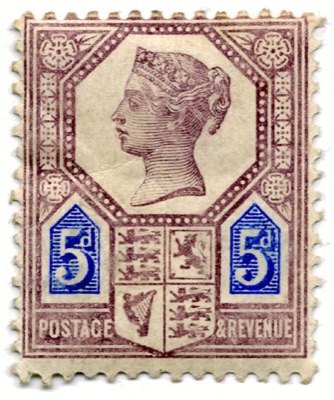
History-focused episodes also do well. The first adhesive postage stamp, issued 1 May 1840 and engraved from a profile by William Wyon, printed across plates 1–11, gives you a ready-made narrative about origins. Famous rarities such as the Inverted Jenny or the British Guiana 1c magenta work the same way as reference points, even if you don't own one yourself — viewers recognize the names and the stories carry an episode on their own. Mixing one of these background segments into an otherwise ordinary episode is an easy way to add context without needing a rare stamp in hand.
For long-running series, keep your condition language consistent across episodes so returning viewers can compare stamps you've shown before. A shared vocabulary for centering, gum status, and condition grading makes your content feel more credible over time, and it doubles as the record-keeping you'd want for the collection anyway. If you ever bring on a guest or answer viewer questions about a specific stamp, this consistency also makes it much easier to explain exactly what you are looking at and why it matters.
What mistakes do new stamp-focused creators make?
The most common mistake is treating the camera session as the only record of a stamp's identification. Notes made for a script are easy to lose; a proper catalogue entry is not. After filming, move each stamp's details — catalogue number, condition, watermark, mount type — into your permanent system, whether that's a spreadsheet or your album pages themselves.
The second common mistake is skipping proper storage between episodes because a stockbook feels temporary. Stamps left loose in a drawer between filming sessions pick up dust, bends, and handling damage faster than ones kept in a properly stored and preserved collection. Treat your working stockbook with the same care as your archive, because it holds the same stamps. A third mistake worth naming is rushing new creators toward expensive material for the sake of a dramatic episode; a well-identified, well-graded common stamp usually makes for better, more teachable content than a rarity you can only describe secondhand.
Content built around a real, well-organized collection tends to outlast content built around a single impressive stamp. Viewers come back for the process — the handling, the identification, the steady accumulation of a themed run — more than for any single episode's highlight. Treat the camera as one more reason to keep careful records, and the habits that make for good footage will also make for a stronger, better-documented collection once the lights are off.
Can I film a stamp collection with ordinary camera lighting?
Yes, but keep the lights cool and angled rather than direct and hot. Continuous heat near paper and gum over long filming sessions can cause subtle damage. Diffused, indirect light also reduces glare on the stamp surface, which matters more for close-up shots than raw brightness.
What is the one piece of equipment every stamp content creator needs?
Stamp tongs. Fingerprints and skin oils show up badly under macro lenses and can mark gum or paper over repeated handling. Tongs keep every on-camera touch clean, and viewers quickly notice when a creator handles stamps correctly.
How do I keep my identification accurate when I'm also trying to perform for the camera?
Separate the two tasks. Identify and note the country, catalogue number, and condition of a stamp before you start recording, then narrate from those notes on camera. Trying to identify a stamp live while also presenting tends to introduce errors.
Should I show rare or famous stamps in my videos?
Famous rarities like the Inverted Jenny or the British Guiana 1c magenta make engaging reference points for viewers, but you do not need to own one to discuss it. Most content works best built around the stamps actually in your collection.
How should I store stamps between filming sessions?
Keep working stamps in glassine envelopes inside a stockbook for quick access during a shoot, then move them into their permanent hingeless album pages once filming wraps. This avoids repeated handling of album pages and keeps your archive separate from your filming set.