A practical guide to setting up tools, lighting, and albums so left-handed collectors can handle, grade, and catalogue stamps comfortably.
Published
Quick answer
Stamp collecting for left-handed people doesn't require special tools: mirror your workspace instead, holding tongs and a magnifier in your dominant hand, positioning light on the opposite side, and choosing hingeless albums or stamp mounts over fiddly hinges.
Key takeaways
- Stamp tools are symmetrical; mirror your workspace instead of buying special gear.
- Position your lamp opposite your writing hand so it never casts a shadow over the stamp.
- Hingeless albums and stamp mounts skip the fiddly hinge-folding step entirely.
- Hold tongs in whichever hand gives you the most control, usually your dominant one.
- Grading and cataloguing depend on light and magnification, not on which hand does the work.
Stamp collecting for left-handed people works exactly like it does for anyone else once you mirror a few small habits: which hand holds the tongs, where the light falls, and how you turn the album page. None of the hobby's core tools are handedness-specific, but a handful of setup choices make handling, grading, and cataloguing noticeably easier.
This guide covers desk setup, tool choice, grading, and the small mistakes that cost collectors of either hand the most time and the most damaged stamps.
Why does handedness matter when handling stamps?
Most stamp tools are built to be used with either hand, but the habits that grow up around them often default to a right-handed layout: light coming from the left, a notepad parked on the right, an album opened a particular way. Copy that layout exactly as a left-handed collector and you end up working in your own shadow, or twisting your wrist every time you reach for the tongs.
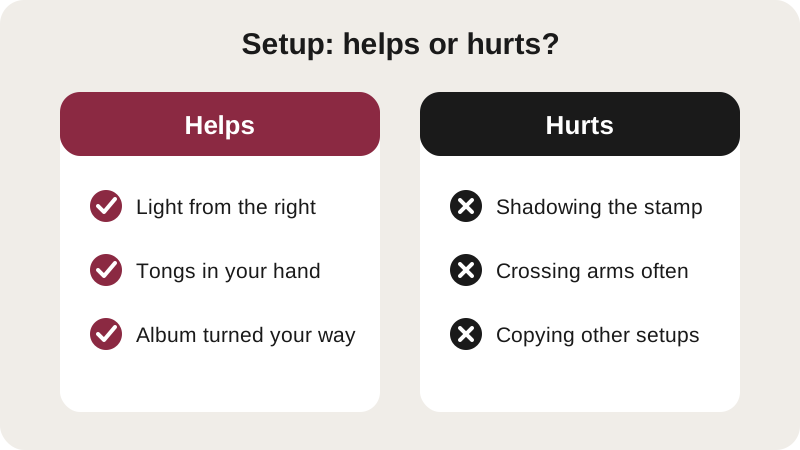
The fix is simply to mirror the setup rather than force yourself into someone else's workspace. If you hold stamp tongs in your left hand, keep your reference catalogue, loupe, and notepad within easy reach of your right hand, and angle your lamp so it lights the stamp without casting a shadow from your writing hand.
How do you set up a left-handed stamp collecting workspace?
A desk arranged around your dominant hand cuts down on fatigue and keeps your stamps safer, since fewer awkward reaches mean fewer accidental creases, drops, or smudged fingerprints.
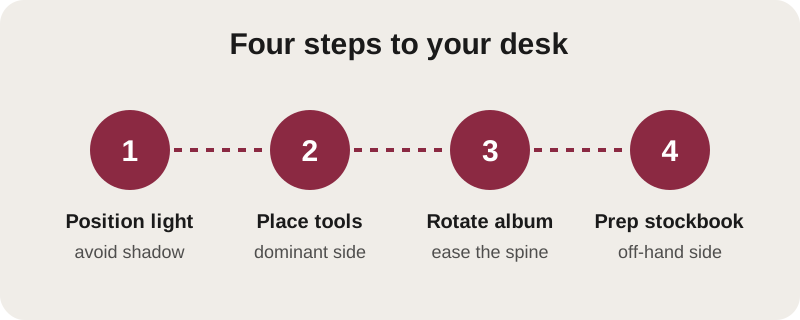
- Position your light source on the side opposite your writing hand, so your hand never casts a shadow over the stamp you are examining.
- Keep your tongs and magnifier on your dominant side, within short reach, so you are not crossing your arms every time you pick one up.
- Open albums away from your body and rotate the page so the spine does not press against your writing wrist as you work.
- Place glassine envelopes and your stockbook on your non-dominant side, ready to receive stamps you have just examined.
These are small adjustments, but they add up over a long cataloguing session. The goal is a desk where nothing forces your writing hand to cross your body just to reach a tool.
Which tools work best for left-handed collectors?
Nearly every standard stamp tool is symmetrical, so the real question is less about buying special gear and more about choosing formats that are comfortable to use with either hand. A few categories are worth a closer look.
| Tool | Why it suits either hand |
|---|---|
| Stamp tongs | Flat or rounded tips work the same no matter which hand grips them; see our guide on how to use stamp tongs safely |
| Loupe or magnifier | Held steady over the stamp rather than dragged across it, so your grip hand rarely matters; details in how to use a stamp magnifier |
| Perforation gauge | Measured by lining up a stamp's teeth against marks spaced every 2 centimetres, which reads the same from either side |
| Hingeless album | Pages mount a stamp without folding a stamp hinge, which removes a fiddly step that depends on fine motor control |
Hingeless albums and stamp mounts are particularly friendly to left-handed collectors because they skip the delicate folding and moistening that a stamp hinge requires. A stamp mount simply slides over the stamp, so you are not trying to fold a tiny strip of gummed paper with one hand while holding the stamp steady with the other. For more on choosing between formats, see our guide to best stamp albums and supplies.
How do you grade and catalogue stamps comfortably?
Grading a stamp's condition depends on what you can see under good light and magnification, not on which hand holds the tools, so left-handed collectors follow exactly the same process as anyone else.
Check centering by eye or against a template, look for thinning or creases under raking light, and confirm whether a stamp is MNH or MH by examining the gum carefully. Our stamp condition grading guide walks through the full scale. Watermark detection works the same way regardless of handedness, whether you use a tray of fluid or a UV lamp; our stamp watermarks guide covers the technique step by step.
When cataloguing, record each stamp's catalogue number, such as its Scott, Michel, or Stanley Gibbons listing, alongside your condition notes in a notebook or spreadsheet. Keep that notebook on your writing-hand side, so you never have to reach across the stamp itself just to jot something down.
What mistakes do left-handed collectors often make?
A handful of habits cause more damage than handedness itself ever does, and most of them are easy to fix once you notice them.
- Working in your own shadow because the lamp was placed for a right-handed layout and never moved to suit you.
- Gripping stamps with bare fingers instead of stamp tongs, which transfers oil onto the paper no matter which hand does it.
- Forcing a hinge-folding technique shown for the opposite hand instead of simply folding the other way.
- Setting a stamp down loose without a glassine envelope while rearranging a workspace, which risks creases and tears.
These tips for left-handed stamp collectors come down to the same principle as the rest of the hobby: careful handling and correct identification matter far more than which hand does the work. If you are just getting started, our beginner's guide to stamp collecting covers the fundamentals, and our guide on how to improve your stamp collecting skills has more general technique tips that apply no matter which hand you favour.
Do left-handed collectors need special stamp tools?
No. Stamp tongs, loupes, perforation gauges, and albums are symmetrical and work the same regardless of which hand holds them. What helps is mirroring your workspace layout, such as lighting and tool placement, to suit your dominant hand rather than copying a right-handed setup exactly.
Which hand should hold the stamp tongs?
Whichever hand gives you the steadiest, most controlled grip, usually your dominant hand. Use the other hand to steady the album page or glassine envelope. There is no correct hand for tongs; comfort and control matter far more than convention.
How should a left-handed collector position their desk lamp?
Place the light source on the side opposite your writing hand. This keeps your hand from casting a shadow across the stamp while you examine centering, gum, or a watermark under the light.
Are hingeless albums easier for left-handed collectors?
Many collectors find them easier because they avoid folding and moistening a stamp hinge, a fiddly step for either hand. A hingeless album or a stamp mount lets you slide the stamp into place without holding a gummed strip steady with your other hand.
Does handedness affect stamp grading accuracy?
No. Grading depends on lighting, magnification, and knowing what to look for in centering, gum, and paper condition. A left-handed collector follows the same grading process as anyone else; only the desk layout needs adjusting.