This article explains what online stamp collecting courses typically teach and how to judge whether a given course is actually worth your time.
Published
Quick answer
Stamp collecting courses online range from free video tutorials to structured philatelic society classes. The best ones teach identification, grading, and cataloguing—not just history—so look for a syllabus with hands-on practice.
Key takeaways
- Good courses teach identification, grading, and cataloguing—not just stamp history.
- Look for lessons on watermarks, perforations, and catalogue numbers like Scott or Michel.
- Free resources from philatelic societies often cover the same ground as paid courses.
- Practise with real stamps, tongs, and a magnifier alongside any course material.
- A certificate doesn't predict value—condition and correct identification still decide that.
Stamp collecting courses online teach you how to identify, grade, and catalogue stamps systematically, usually through video lessons, reading guides, and practice exercises. Some are run by philatelic societies, others are free tutorials from collector communities and museums.
The format has grown popular because it lets people learn at their own pace, without needing a local club meeting nearby. Whether you pay for a structured program or follow free material, the underlying goal is the same: turning vague interest in old stamps into a repeatable method for examining them.
What do online stamp collecting courses actually teach?
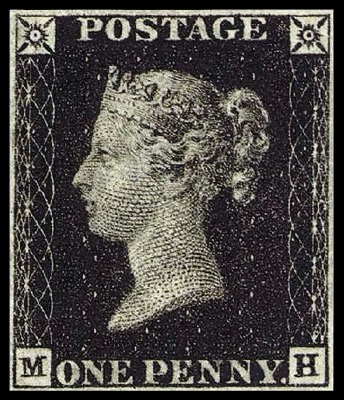
Most courses walk through the same core skills regardless of format: recognising a stamp's country of origin and issue date, measuring perforations with a gauge, detecting a watermark, and understanding grading terms like MNH and MH. Many also explain how to read Scott, Michel, or Stanley Gibbons catalogue numbers, since those numbers are the common language collectors use to describe a stamp precisely.
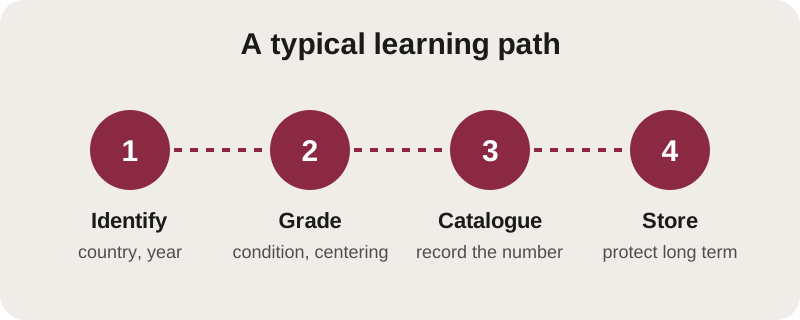
Course length and depth vary widely. Some are single-session introductions aimed at people who just started a stamp collection, while others run for months and include assignments on era-specific topics or thematic collecting. A good course should make you faster and more confident at the tasks you already do by hand: checking a watermark, comparing a design against a reference image, and writing down the correct catalogue number.
Some programs also cover related skills that rarely get attention elsewhere, such as recognising plates used in early printings, telling a reprint apart from an original issue, or spotting the difference between a stamp still carrying original gum and one that has been reprocessed. These details matter more to serious identification than most beginners expect, and a course that spends real time on them is usually worth more than one that rushes through a long list of countries.
- Read the syllabus first: look for named skills like watermark detection or perforation measurement, not vague chapter titles.
- Check for practice material: a course should give you stamps or images to examine, not just slides to watch.
- Confirm catalogue coverage: make sure it explains at least one system—Scott, Michel, or Stanley Gibbons—in enough detail to use afterward.
- Look for feedback options: a forum, instructor, or peer group to check your identifications against.
How do you choose a good course?
The quality of a course matters more than its length or price. Look for a syllabus that names specific, checkable skills—reading a watermark, using a perforation gauge, grading centering—rather than vague promises about building a valuable collection quickly.
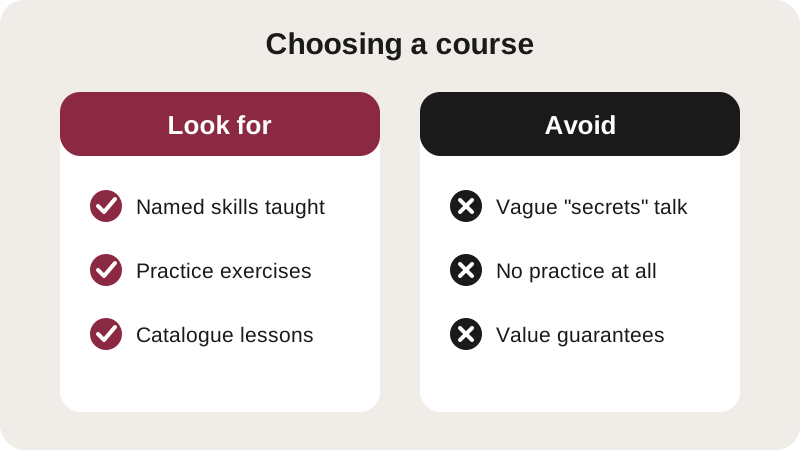
Free and paid options each have a place, depending on what you want out of the course:
| Course type | Typical content | Best for |
|---|---|---|
| Free video or article series | Basic identification, handling, storage | New collectors testing interest |
| Philatelic society classes | Grading, watermarks, catalogue systems, structured feedback | Collectors who want a syllabus and peer discussion |
| Specialised workshops | A single country, era, or theme in depth | Collectors who already know the basics |
Price is not a reliable signal of quality on its own. Some of the most thorough material comes from volunteer-run philatelic societies that charge nothing beyond membership, while some paid workshops are little more than recorded talks with no exercises. Ask what you will actually produce by the end—a filled-in worksheet, a graded sample stamp, a short written identification—rather than just what topics will be "covered."
What skills matter more than finishing a course?
No course replaces time spent handling stamps with the right tools. Learning to use stamp tongs safely and use a magnifier correctly will do more for your eye than any certificate, because grading and identification are physical skills you build through repetition.
- Watermark detection: holding a stamp to a UV lamp or watermark tray and recognising the pattern
- Perforation measurement: using a gauge against the standard 2 centimetre span to get a precise reading
- Centering judgment: comparing margins by eye before assigning a grade
- Catalogue lookup: matching a stamp to its correct Scott, Michel, or Stanley Gibbons number
These four skills reinforce each other. A stamp that looks unusual under a magnifier might turn out to be a known plate variety once you check the catalogue entry, and a watermark you cannot place on your own often becomes obvious once a course or reference image shows you what to look for. Repetition across many stamps, not a single lesson, is what makes these judgments fast and reliable.
Can you learn stamp collecting without a formal course?
Yes, and many experienced collectors never take one. A library of reference material, a stamp identification guide, and a willingness to compare your stamps against known examples will teach you most of what a paid course covers.
- Read a stamp collecting glossary to learn the vocabulary before you need it mid-lesson
- Study a watermarks guide and practise on stamps you already own
- Check catalogue numbers using a free online Scott catalogue instead of buying a full set upfront
- Join a local or online club where experienced collectors answer specific questions
Self-study rewards patience. Keep a stockbook or hingeless album nearby so you can mount and compare stamps as you learn, and resist the urge to use a stamp hinge on anything you suspect might be valuable until you have graded it properly. Working through a handful of stamps thoroughly, from cover to catalogue entry, teaches more than skimming a long course without ever picking up tongs or a gauge.
How does a course fit with building and organising your collection?
Whatever you learn, the point is to apply it consistently across your whole collection, not just to the handful of stamps in a lesson. Use what a course teaches about grading and catalogue numbers to improve your overall collecting skills, then carry that habit into every new stamp you add, from common definitives to anything resembling a famous rarity like the Inverted Jenny or the British Guiana 1c magenta.
Store what you learn alongside your stamps, not just in your notes. A glassine envelope keeps an unmounted stamp safe while you decide on its grade, and recording the catalogue number as soon as you identify it saves you from repeating the research later. Courses teach the method; your own collection is where that method actually gets tested, stamp by stamp.
Over time, the course material fades from memory while the habits it builds stay useful: checking a watermark before assuming a stamp is common, measuring perforations instead of guessing, and writing down a catalogue number the first time you look it up. Those habits, repeated across hundreds of stamps, matter far more than which course you took or how long it ran.
Are online stamp collecting courses worth it for beginners?
Yes, if the syllabus covers hands-on identification and grading rather than just history. A course that teaches you to measure perforations, read watermarks, and record catalogue numbers builds skills you will use on every stamp you own, regardless of where you learned them.
Do I need a course to learn to grade stamps?
No. Grading is a learnable skill from written guides, practice with a magnifier, and comparing your stamps against reference images. A course can speed this up, but regular practice with your own collection teaches you just as much over time.
What catalogue systems should a course cover?
Look for courses that explain at least one major catalogue—Scott, Stanley Gibbons, or Michel—and show how to match a stamp's design, watermark, and perforation to the correct listing number. This numbering system is how collectors describe stamps precisely.
Can a free course teach the same skills as a paid one?
Often, yes. Many philatelic societies and collector communities publish free lessons covering identification, grading, and storage. Paid courses may add structured assignments or feedback, but the core skills are the same wherever you learn them.
How long does it take to learn the basics of stamp collecting?
Most beginners can learn the basics—reading a watermark, measuring perforations, finding a catalogue number—within a few weeks of regular practice. Depth comes from handling many stamps over time, not from finishing any single course quickly.