A practical guide to identifying Canadian stamps by inscription, portrait, watermark, and perforation before recording them with a catalogue number.
Published
Quick answer
To identify Canadian stamps, check the bilingual inscriptions, the monarch's portrait or national symbol, and the printing era, then match those details to the correct Scott catalogue number.
Key takeaways
- Canadian stamps print 'CANADA' or bilingual Canada Post text, unlike countries that omit the name entirely.
- The portrait or design on the stamp narrows the printing era before you open a catalogue.
- Watermarks and perforation gauges separate look-alike printings of the same design.
- Match confirmed details to a Scott, Stanley Gibbons, or Michel number before filing the stamp.
- Keep unsorted stamps in a glassine envelope or stockbook until identification is confirmed.
To identify Canadian stamps, start by reading the inscription, checking the portrait or main design, and matching those details to the right era before you look up a catalogue number. This guide walks through each step so you can place almost any Canadian stamp with confidence.
What's the fastest way to tell a stamp is Canadian?
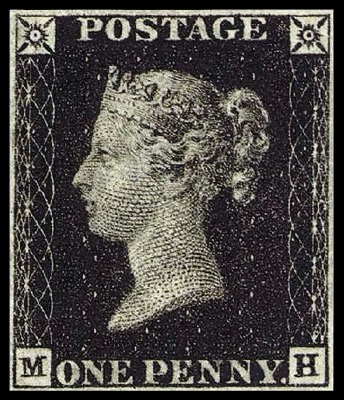
Canadian stamps almost always print the country name somewhere on the design, either as "CANADA" alone or as the bilingual wording "Postes Canada Post." That single detail already sets them apart from a country like Britain, which has never printed its own name on a stamp since the Penny Black of 1 May 1840 made the monarch's portrait identification enough on its own.
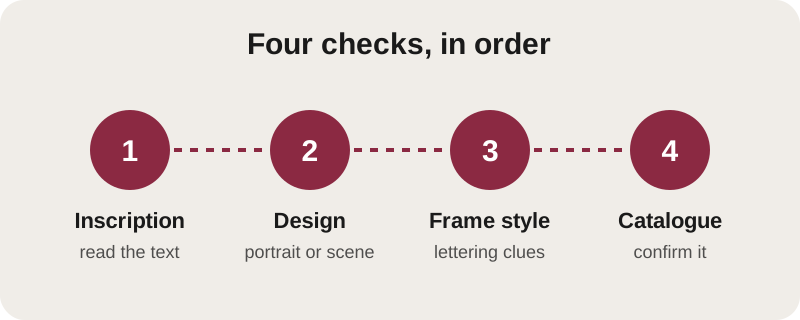
- Read the inscription: look for "CANADA" or the bilingual "Postes Canada Post" wording along the frame.
- Check the central design: an engraved portrait points to an earlier reign; a pictorial scene points to a later definitive or commemorative.
- Compare the frame and lettering style: each printing era uses a distinct engraving weight and typeface.
- Match the result to a catalogue number: confirm it against Scott, Stanley Gibbons, or Michel listings for Canada.
Beyond the inscription, look closely at the central design. Early Canadian stamps carry an engraved profile portrait, in the same tradition as the portrait William Wyon designed for Britain's earliest issues. Later Canadian series move away from strict portraiture toward national symbols: maple leaves, beavers, wildlife, parliament buildings, and sporting or anniversary themes. Seeing a profile portrait paired with bilingual text is one of the clearest signs you are holding a Canadian definitive rather than a stamp from another Commonwealth country using a similar design convention.
How can you tell which era a Canadian stamp is from?
The portrait or design on a Canadian stamp tells you roughly when it was issued, because each reigning monarch or pictorial series appears across a fairly specific span of years. Lining up what you see with a short mental timeline narrows your search before you ever open a catalogue.
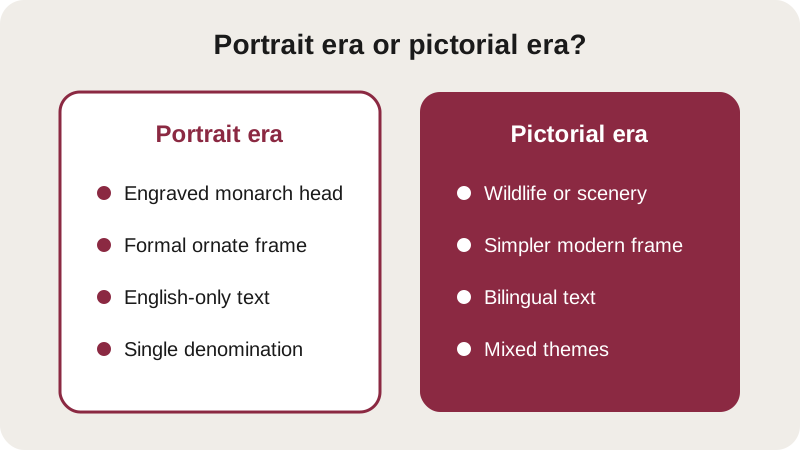
Early Canadian issues carry a Victorian profile portrait. The following decades move through King Edward VII, King George V, and King George VI, each with a recognisable engraving style and frame. From the Elizabeth II years onward, Canada Post increasingly favoured pictorial definitives over strict portrait series, mixing wildlife, industry, sport, and anniversary themes with the occasional commemorative portrait set. Once you've narrowed the likely monarch or design family, cross-check the frame style, the lettering weight, and the denomination format against a Scott catalogue listing covering Canadian definitive stamp eras.
If you're working through a mixed batch of unfamiliar issues, it helps to first narrow the country of origin before worrying about the exact year. Canada's design language, especially the bilingual text, is distinctive enough that this step usually goes quickly once you know what to look for.
How do watermarks and perforations narrow down a Canadian stamp?
Two Canadian stamps can share the same design yet belong to entirely different printings, and the difference often comes down to watermark and perforation rather than anything visible on the surface. These two checks resolve most identification puzzles that the portrait or design alone cannot settle.
Hold the stamp up to a light, or use a watermark tray, to check for a watermark in the paper. Some early Canadian printings used watermarked stock while later ones used none at all, so a watermark's presence or absence by itself can confirm which printing you're holding among several that look otherwise identical. For perforations, lay the stamp on a gauge and count how many teeth fall across 2 centimetres of the edge; a small difference in that reading is sometimes the only thing separating two otherwise matching Canadian issues. Handle the stamp with stamp tongs throughout this check, since oils from fingers can affect how it reacts under a watermark tray or UV lamp later. A full watermark guide covers detection methods in more depth.
It's also worth examining the design closely for printing flaws. Even common-looking Canadian definitives occasionally hide a misplaced colour, a missing element, or a doubled impression. Famous cases like the Inverted Jenny show how dramatically a misprint can change a stamp's identity from an ordinary issue into something collectors specifically search for, so note anything that looks even slightly different from your reference image before setting the stamp aside as identified.
How do you record a Canadian stamp once you've identified it?
Once you've confirmed the country, era, and printing details, write down the catalogue number, denomination, colour, and condition before the stamp goes back into storage. A consistent record is what turns a pile of identified stamps into an organised collection rather than a guessing game you repeat every time you open the album.
Scott, Stanley Gibbons, and Michel each publish their own numbering for Canadian issues, so pick one system and use it consistently across your album or stockbook rather than mixing references. Note whether the stamp is mint never hinged (MNH) or mint hinged (MH), since that status affects how you mount it: a stamp hinge is appropriate for hinged stock, but an MNH stamp belongs in a stamp mount or on a page in a hingeless album that never touches the gum. Grading centering at this stage, using the approach described in the condition grading guide, also saves you from re-examining the same stamp a second time later.
How should you store Canadian stamps while you work through them?
Keep unidentified or unsorted Canadian stamps in a glassine envelope or a stockbook until you've confirmed each one, and always lift them with stamp tongs rather than bare fingers to avoid oils and creasing. A UV lamp is also worth keeping close at hand, since it can reveal paper repairs or chemical changes that plain daylight misses entirely.
Once a batch has been sorted, moving confirmed stamps into their final album pages keeps your working pile small and your identified collection reliable. If you want a broader sense of what your Canadian material might represent once it's properly identified, this overview of Canadian stamps is a useful next read, though identification and correct cataloguing always come first. For a quicker first pass through a large or unfamiliar batch, the app can help you narrow down country and era from a photo before you reach for the gauge and watermark tray.
How do I know if a stamp is from Canada?
Look for the word 'CANADA' printed on the stamp, often alongside bilingual wording such as 'Postes Canada Post.' Early issues show a monarch's portrait; later ones show maple leaves, wildlife, or national landmarks. That combination of inscription and design is usually enough to confirm the country.
What's the easiest way to date an old Canadian stamp?
Start with the portrait or central design, which points to a monarch's reign or a design series. Then narrow the exact year using a Scott catalogue listing, checking frame style, lettering, and denomination format against the entries for that period.
Do Canadian stamps have watermarks?
Some early Canadian printings used watermarked paper, visible by holding the stamp to light or using a watermark tray, while most later issues carry none. Checking for a watermark can confirm which printing of a shared design you actually have.
How should I catalogue a Canadian stamp once I've identified it?
Record its catalogue number, denomination, colour, perforation, and condition, noting whether it's mint never hinged or mint hinged, in a stockbook or album page. Photographing it afterward makes it easy to track centering and condition over time.
What tools help confirm a Canadian stamp's identity?
Stamp tongs for safe handling, a perforation gauge measured over 2 centimetres, a UV lamp for checking paper and repairs, and a loupe for fine engraving detail all help confirm exactly which Canadian printing you're looking at.