A practical guide to identifying Japanese stamps by inscription, chrysanthemum crest, design era, watermark, and perforation before cataloging them.
Published
Quick answer
How to identify Japanese stamps starts with the kanji inscription (often 郵便) and the imperial chrysanthemum crest, then narrows to an exact era and catalog number using design style, watermark, and perforation checks.
Key takeaways
- Look for kanji such as 郵便 and the imperial chrysanthemum crest first.
- Design style narrows a stamp to Meiji, Taisho, Showa, Heisei, or Reiwa.
- Watermarks and perforation gauges confirm the exact printing within an era.
- Match era and design to a Scott, Michel, or Stanley Gibbons catalog number.
- Kanji alone isn't proof of origin — Ryukyu issues look similar but differ.
How to identify Japanese stamps comes down to four checks: the kanji inscription, the imperial chrysanthemum crest, the design era, and the watermark or perforation pattern. Work through them in that order and you can place almost any Japanese stamp before you ever open a catalog.
What makes a stamp look Japanese in the first place?
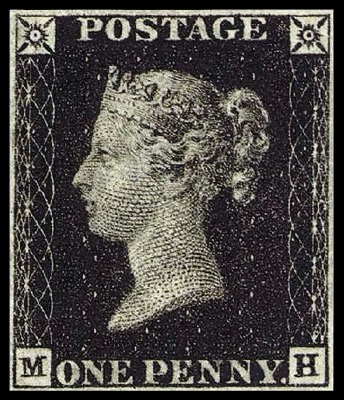
Most Japanese stamps carry the kanji 郵便 (yūbin, "mail") somewhere in the design, often paired with 日本 (Nihon, "Japan"). Early issues from the 1870s relied on this script alone, since Japan had not yet adopted Latin lettering for the international mail its stamps paid for.
From the 1880s onward, a sixteen-petal chrysanthemum crest — the Japanese imperial seal — appears in the corners or center of many definitive series. The crest is a strong visual anchor: if you see it alongside the yūbin inscription, you are almost certainly holding a Japanese stamp rather than a Chinese, Korean, or Ryukyu Islands issue that uses similar characters. For a broader walkthrough of spotting a country from design clues alone, see how to identify a stamp's country of origin.
If you are sorting a mixed lot and haven't settled on Japan specifically yet, the general stamp identification guide covers how to narrow down country and era for any unfamiliar stamp before you specialize.
How do you tell which era a Japanese stamp is from?
Design style narrows a Japanese stamp down to one of five broad eras, each with a recognizable look you can learn to spot at a glance before checking any catalog number.
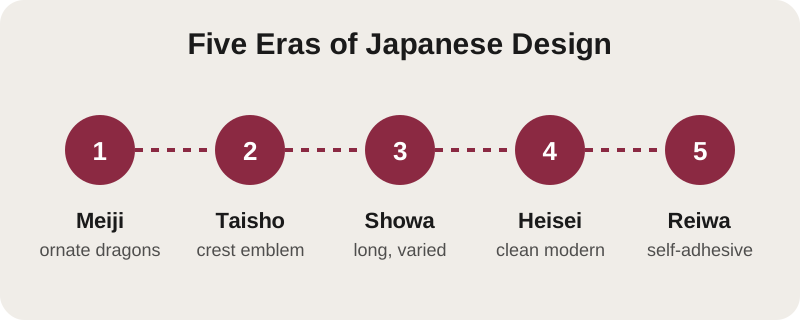
Meiji-era stamps favor dense engraving, dragons, and ornate frames. Taisho-era issues simplify the design into crest medallions. Showa, the longest era, spans everything from stark wartime issues printed on thin paper to the bright, detailed commemoratives of the postwar decades — it is the era where design alone tells you the least, and paper and watermark start to matter more. Heisei and Reiwa issues are almost always full color, printed on bright white stock, and many recent definitives are self-adhesive rather than gummed. Commemorative issues complicate this a little further, since Japan has produced commemoratives in every era and their artwork does not always match the plain definitives most collectors learn first; when in doubt, cross-check the inscription style against the era's typical printing method rather than relying on color alone.
How do watermarks and paper narrow down the exact issue?
Once you know the rough era, the paper itself often confirms the exact printing. Hold the stamp to a light or use a watermark tray: several pre-war Japanese definitives were printed on paper carrying a repeated cherry-blossom watermark, while many later issues are unwatermarked.
Paper texture shifts with the era too. Wartime Showa issues are frequently printed on thin, rough stock due to material shortages, while postwar and modern issues use heavier, smoother paper. Comparing paper under raking light next to a UV lamp can also show chalky surfacing used on some modern issues, another clue that narrows the printing period. Measuring the perforation gauge — holes per 2 centimetres along the edge — adds another data point, since perforation size changed as Japan's printing equipment was modernized. See the stamp perforations guide for how to use a gauge correctly, and the watermarks guide for detecting faint patterns.
How do you catalog a Japanese stamp once you've identified it?
Identification and cataloging are two different jobs: identification tells you what the stamp is, cataloging gives it a number you can search, insure, and record against.
- Confirm the country of origin from the inscription and crest.
- Match the design and paper to one of the five design eras.
- Check the watermark and measure the perforation gauge.
- Cross-reference the design and era against Scott, Michel, or Stanley Gibbons listings to find the matching catalog number.
- Record the catalog number and condition, then house the stamp in a stockbook or hingeless album.
Note whether the stamp is mint never hinged (MNH) or mint hinged (MH), since this affects which catalog line applies and how you should mount it — a stamp hinge or stamp mount works differently depending on which state the gum is in. If you don't have physical catalogs on hand, see finding a Scott catalog online for free lookup options before you commit to a number. Once logged, store the stamp away from light and humidity; the storage and preservation guide covers how a stockbook, hingeless album, and acid-free materials work together to protect it long after you've filed the catalog number.
How do you confirm identification and avoid fakes?
A confident identification rests on more than one clue lining up — design, inscription, watermark, and perforation should all point to the same era and issue before you commit to a catalog number.
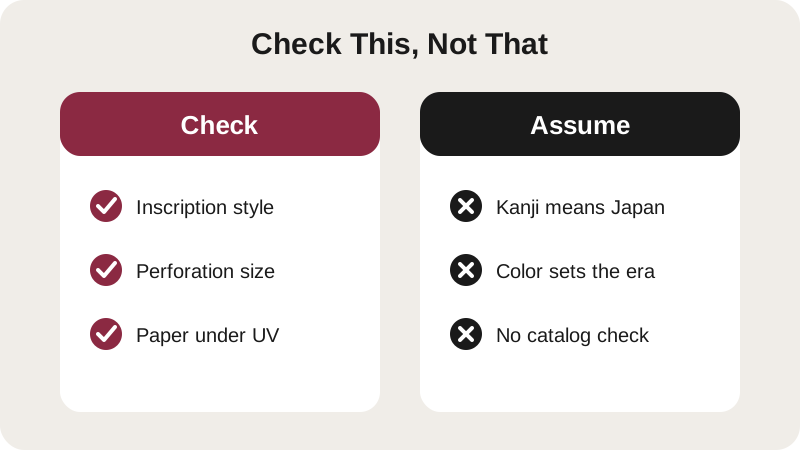
Reprints and forged overprints exist for some early Japanese issues, particularly where original print runs were small and collector demand is high. A UV lamp can reveal paper or gum that fluoresces differently from a genuine period example, and comparing centering and perforation against a verified reference copy helps catch forgeries before you log them. This matters most for scarcer early Meiji and wartime issues, where genuine examples are limited and careful buyers compare every measurable detail rather than trusting appearance alone. For a general walkthrough of authentication red flags, see how to spot fake stamps, and for grading the condition of a confirmed genuine stamp, see the condition grading guide.
How can you tell if a stamp is Japanese without reading Japanese?
Look for the kanji 郵便 (mail) and a sixteen-petal chrysanthemum crest, the imperial seal that appears on many definitive series from the 1880s onward. Combined with an engraving style that favors fine detail over bold color, these two visual markers are usually enough to place a stamp as Japanese even without reading the script.
What is the chrysanthemum crest seen on Japanese stamps?
It is the Japanese imperial seal, a stylized sixteen-petal chrysanthemum that appears in the corners or center of many Japanese definitive stamps starting in the late 1800s. Its presence alongside the yūbin inscription is one of the strongest single clues that a stamp originates from Japan rather than a neighboring country.
Do Japanese stamps have watermarks?
Some do and some don't. Several pre-war Japanese definitives were printed on paper carrying a repeated cherry-blossom watermark, visible with a watermark tray or strong backlight, while many later issues are unwatermarked. Checking for a watermark helps confirm the printing period once you've already narrowed the design to a rough era.
How do you find the catalog number for a Japanese stamp?
Once you've confirmed the design, era, watermark, and perforation, cross-reference those details against Scott, Michel, or Stanley Gibbons listings for Japan. The combination of era-specific design and measurable paper details usually narrows the match to one or two catalog entries, which you can confirm by comparing printed detail side by side.
Can Japanese stamps be reprints or forgeries?
Yes, particularly scarcer early Meiji and wartime issues. A UV lamp can reveal paper or gum that fluoresces differently from a genuine period example, and comparing perforation gauge and centering against a verified reference copy helps catch reprints before you catalog a stamp as an original.