A step-by-step guide to identifying Italian stamps by inscription, overprint, watermark, and perforation before cataloguing and grading them.
Published
Quick answer
Here's how to identify Italian stamps: read the top inscription first (REGNO D'ITALIA or POSTE ITALIANE), then check the watermark and perforation, and match the design to a Scott, Michel, or Stanley Gibbons number.
Key takeaways
- The inscription (REGNO D'ITALIA or POSTE ITALIANE) dates a stamp to kingdom or republic era.
- Colonial and occupation overprints are catalogued separately from regular Italian issues.
- A watermark tray or UV lamp reveals paper clues that plain light misses.
- Centering and gum condition (MNH or MH) decide grade more than age alone.
- Record the catalogue number from Scott, Michel, or Stanley Gibbons once identified.
Identifying Italian stamps starts with reading the inscription across the top of the design. Here's how to identify Italian stamps in a logical order: inscription first, then overprint, watermark, perforation, and finally the catalogue number, so you never have to guess.
What's the fastest way to identify an unfamiliar Italian stamp?

Work from the outside in. Start with the inscription across the top of the design, then look at any overprint, the watermark, the perforation gauge, and finally the printed design itself. Each layer narrows the possibilities until only one catalogue entry fits.
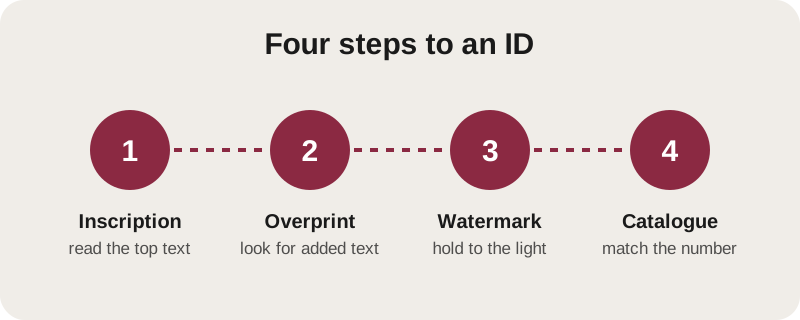
Most Italian stamps fall into just a handful of inscription families, so this order gets you to the right catalogue section quickly, long before you need to measure a single perforation hole. Skipping straight to the design and trying to match a picture is slower and more error-prone, because many designs were reused across decades with only small printing differences between them.
- Read the inscription: note whether it says REGNO D'ITALIA, REPUBBLICA ITALIANA, POSTE ITALIANE, or a colonial country name.
- Check for an overprint: look for extra text or a new value printed over the original design.
- Look at the watermark: check the paper with a watermark tray or a UV lamp if nothing shows under normal light.
- Measure the perforation: count the teeth across 2 centimetres on each edge of the stamp.
- Match the design to a catalogue number: confirm against Scott, Michel, or Stanley Gibbons.
What do the inscriptions tell you about era and issuing authority?
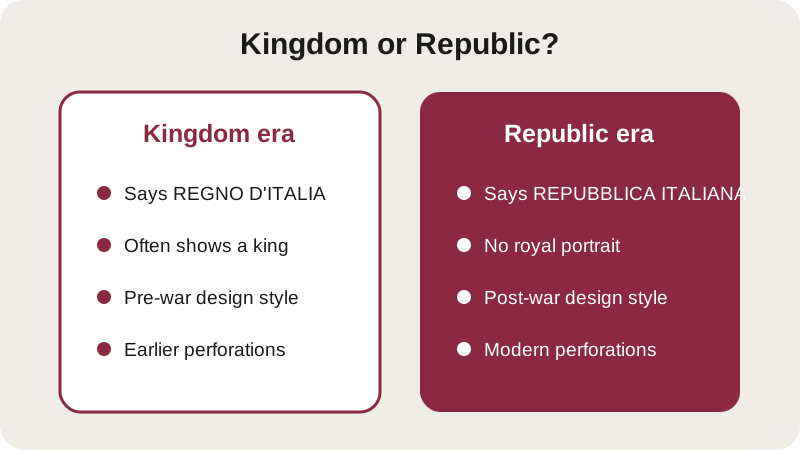
The inscription is the single biggest clue on an Italian stamp. Regno d'Italia marks the Kingdom era, while Repubblica Italiana or simply Poste Italiane marks the post-war republic. Occupation and colonial issues carry their own country names printed over or alongside the Italian design.
Vatican City and San Marino stamps look similar in style but are not Italian issues at all. They are identified by their own inscriptions, Poste Vaticane and San Marino, and catalogued separately. The broader visual cues in identifying a stamp's country of origin apply just as well to Italian material as anywhere else, and the same inscription-first approach works for identifying French stamps too. Building this habit also makes it easier to sort mixed European lots quickly, since a glance at the top line of text tells you which country folder a stamp belongs in before you look at anything else.
How do watermarks and perforations narrow down the exact issue?
Once the inscription places a stamp in its era, the watermark and perforation measurement usually settle which specific printing you are holding. Many Italian definitives were reprinted over long periods with small, deliberate changes to the paper and the perforation.
Hold the stamp face-down and look for a watermark pattern in the paper itself. If nothing shows under normal light, try a watermark tray or a UV lamp instead. Then lay the stamp over a perforation gauge and count how many teeth fall across 2 centimetres on each edge; a half-point difference can separate two listings that otherwise look identical. Long-running definitive series are the trickiest, since the same design can appear with several different watermarks and perforation gauges across its printing life, and only the exact combination matches a single catalogue line. For more detail on reading paper clues, see the guide to stamp watermarks.
How do you catalogue an Italian stamp once you've identified it?
Once you know the era, the overprint if any, and the watermark or perforation variety, you can look up the matching catalogue number. Italian stamps are listed in all three major catalogues, and the numbers rarely match across them.
| Catalogue | What it's useful for |
|---|---|
| Scott | Common reference for US-based collectors and online listings |
| Stanley Gibbons | Widely used in UK and Commonwealth-facing listings |
| Michel | Detailed listing of European issues, including watermark and perforation varieties |
Write the catalogue number in pencil on a stock card or directly in your album next to the stamp, along with the watermark and perforation details you confirmed. That note saves you from identifying the same stamp twice, and it gives anyone else looking through your collection a quick way to check your work later.
How should you grade and store Italian stamps once they're identified?
Condition decides how a stamp is described far more than its age does. Centering, gum, and any thinning or repair all factor into the grade, and Italian issues are graded the same way as stamps from any other country.
Check whether the gum is intact and never hinged (MNH) or lightly hinged (MH), since this changes how the stamp is described in a catalogue entry. Use stamp tongs rather than your fingers to avoid oils and creases, and mount the stamp with a stamp hinge or a clear stamp mount depending on whether you want it removable or permanently fixed. For a full walkthrough of grading, see the stamp condition grading guide.
For storage, a hingeless album keeps mounted stamps flat and protected, while loose or duplicate material is safest in a glassine envelope inside a stockbook. Keep both out of direct light and humidity. The storage and preservation guide covers the full setup in more detail, and once identification is settled, this overview of Italian stamps is worth reading before you decide what to do with the collection next.
Identification first, valuation second: once you can read an Italian stamp's inscription, watermark, and perforation confidently, cataloguing and grading the rest of the collection becomes routine, and each new stamp you pick up takes only a minute or two to place correctly.
How do I tell a Kingdom of Italy stamp from a Republic one?
Read the inscription across the top. Regno d'Italia marks stamps from the Kingdom era, while Repubblica Italiana or Poste Italiane marks the postwar republic. Kingdom-era stamps often show a royal portrait, while republic-era stamps generally do not. Checking the inscription first is faster than comparing designs alone.
Are Vatican City and San Marino stamps the same as Italian stamps?
No. Vatican City stamps are inscribed Poste Vaticane and San Marino stamps are inscribed San Marino. They share a similar printing style and are often collected alongside Italian material, but each is catalogued under its own country listing, not under Italy.
What tool do I need to check an Italian stamp's watermark?
A watermark tray with dark watermark fluid works well, or you can hold the stamp face-down under a UV lamp or strong light. Many Italian definitives exist with and without a watermark, so checking is often the step that confirms the exact catalogue listing.
Why do some Italian-looking stamps have a different country name printed on them?
Italy issued stamps for its colonies and occupied territories using the same base designs, with the territory's name overprinted in place of Italia. These overprinted issues are catalogued separately from regular Italian stamps, even though the underlying design looks identical.