This guide explains how to identify German stamps by reading their country inscription, matching the design to the correct historical era, and confirming the issue with watermark, perforation, and Michel catalogue checks.
Quick answer
To identify German stamps, read the country inscription first (Deutsches Reich, DDR, Bundesrepublik Deutschland, or a state name), match it to its historical era, then check the watermark, perforation, and Michel catalogue number to confirm the exact issue.
Key takeaways
- German stamps almost always print their issuing country or state name somewhere in the design.
- The inscription narrows the era before you check anything else about the stamp.
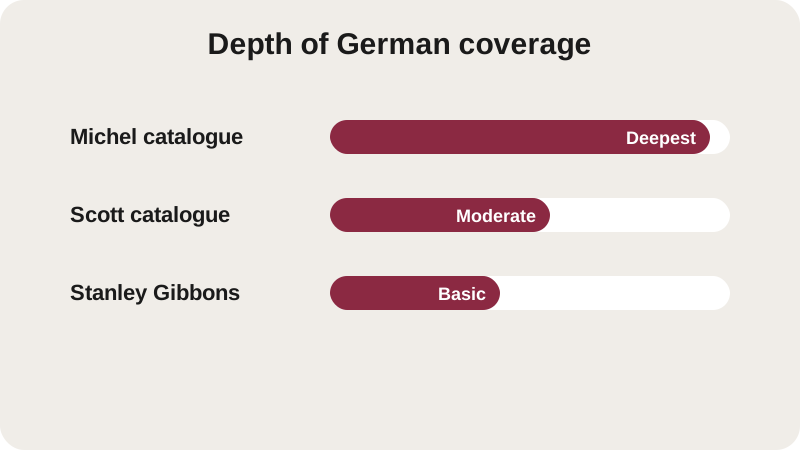
- Michel is the standard catalogue for German stamps; Scott and Stanley Gibbons cover fewer varieties.
- Watermarks and perforation checks confirm an identification when two eras used similar designs.
- Store identified stamps in a stockbook or hingeless album, never loose in a drawer.
To identify German stamps, start by reading the country inscription printed on the design, then match that wording to the correct historical era before you even reach for a catalogue. Most German stamps name their issuing authority somewhere in the frame, and that single detail does more identification work than any other step.
What's the fastest way to identify a German stamp?
Every genuine German stamp carries a printed clue to its origin, so the fastest route to an identification is reading before magnifying. Work through the inscription, the era it points to, and the physical details in that order rather than jumping straight to a price guide.
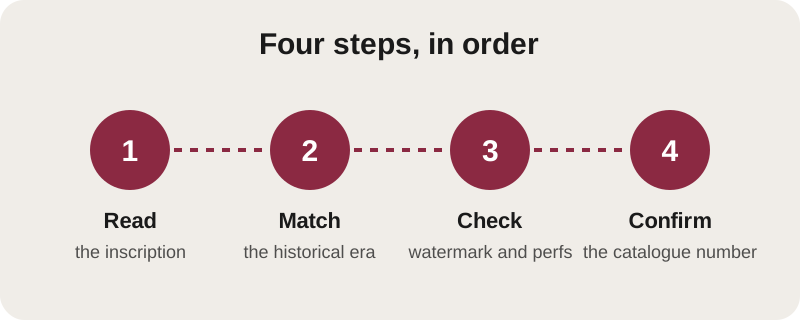
- Read the inscription: note the exact country or state name printed on the stamp, including any small-print regional name on earlier German states issues.
- Match the era: compare the inscription against the table below to work out which decades and political period it belongs to.
- Check the physical details: hold the stamp to light for a watermark, measure the perforation, and note the paper and gum.
- Confirm with a catalogue number: look up the design and inscription in Michel, Scott, or Stanley Gibbons to settle on the exact issue.
This sequence works for a single loose stamp pulled from an envelope just as well as it does for a full page you inherited. For a broader refresher on reading inscriptions on any stamp, see identifying a stamp's country of origin.
How do you tell German eras apart by inscription?
German philately spans several political periods, and each one used a distinct inscription. Learning to recognise these phrases on sight will sort the vast majority of German stamps before you open a single reference book.
| Inscription | Period | Notes |
|---|---|---|
| German state names (Bayern, Sachsen, Württemberg, and others) | Before 1871 | Issued by individual kingdoms before German unification |
| Deutsches Reich | 1871 to 1945 | Covers the Empire, Weimar Republic, and Third Reich periods |
| Allied occupation overprints | 1945 to 1949 | Base stamps overprinted by occupying zones after the war |
| Deutsche Post / DDR | 1949 to 1990 | East Germany, the German Democratic Republic |
| Deutsche Bundespost | 1949 to 1990 | West Germany, the Federal Republic |
| Deutschland / Bundesrepublik Deutschland | 1990 to present | Reunified Germany |
Watch also for special inscriptions like Danzig and Saar, which marked semi-autonomous postal territories and are often collected as separate series. Overprinted issues from these areas are heavily studied — and heavily forged — because the overprint itself, not the base stamp, is what makes them scarce.
Which catalogue should you use for German stamps?
Michel is the catalogue built specifically around German philately, and it lists far more printing varieties and overprint types than general-purpose catalogues. Scott and Stanley Gibbons are useful for a general overview but were not designed with German specialisation in mind.
Michel numbers also travel with German stamps in most dealer stock and auction descriptions worldwide, so learning to read a Michel number is worth the effort even if your main reference is Scott. If finding a free catalogue lookup is the blocker, start with finding a Scott catalogue online for free and cross-reference from there. For a sense of which German issues attract the most attention once identified, see the most valuable German stamps in 2026 and which German stamps are worth money.
How do you check watermarks and perforations on German stamps?
Several German eras reused very similar designs with only the watermark or perforation changed, so these physical checks are often what separates a common stamp from a scarce printing variety. Skipping them is the most common way collectors misidentify an otherwise correctly-read inscription.
Hold the stamp face-down over a dark surface or use watermark fluid to reveal the pattern pressed into the paper during manufacture. Then measure the perforation teeth across a span of 2 centimetres with a perforation gauge, since many German definitive series were reissued with a finer or coarser perforation later in their run. A UV lamp is useful too, revealing paper differences and some forged overprints that look convincing under ordinary light.
For a deeper walkthrough of this process on any country's stamps, see the stamp watermarks guide and stamp perforations guide.
How should you store and catalogue your German stamps?
Once a German stamp is identified, record its catalogue number, era, and condition before it goes back into storage, so you are not re-identifying the same stamp a year later. A simple log paired with the physical stamp saves far more time than memory alone.
Use a stockbook for stamps you are still sorting by era and inscription, and move confirmed pieces into a hingeless album once identified, using stamp mounts rather than a stamp hinge on unused material so you preserve original gum condition. Note whether each stamp is MNH or MH at the same time you record its catalogue number, since gum condition affects how the stamp should be handled going forward. Loose stamps waiting to be sorted are safest in a glassine envelope rather than a drawer or folded paper.
For general grading and storage practice that applies across any country's stamps, including German issues, see the stamp condition grading guide and guide to storing and preserving a stamp collection. Reading the inscription correctly and recording it alongside centering and condition notes is what turns a pile of German stamps into an organised, searchable collection. If you want a quick second opinion on an inscription or era while you work, the app can help narrow down a match from a photo before you confirm it in Michel.
What does 'Deutsches Reich' mean on a stamp?
Deutsches Reich means 'German Empire' or 'German Realm' and appears on stamps issued between unification in 1871 and the end of the Second World War, covering the Empire, the Weimar Republic, and the Third Reich period.
How do I tell a DDR stamp from a Bundesrepublik stamp?
DDR stamps name the German Democratic Republic and were issued in East Germany from 1949 to 1990. Bundesrepublik Deutschland stamps were issued in West Germany over the same period. Both inscriptions appear directly on the stamp, so reading it is usually enough to separate them.
Do I need the Michel catalogue, or will Scott work?
Scott and Stanley Gibbons list major German issues and are fine for general reference, but Michel was built specifically around German philately and lists far more printing varieties, shades, and overprint types, so serious German collectors eventually rely on it.
How do I spot a forged German overprint?
Overprints on German states, colonies, and occupation issues are among the most forged areas in philately. Compare the overprint's type style, ink colour, and placement to a genuine reference copy, check for watermark, and use a UV lamp to look for inconsistencies invisible in normal light.
What's the first thing to check on an unidentified German-looking stamp?
Read the inscription printed on the stamp itself. German issues almost always name their issuing authority, whether that's a historical state, Deutsches Reich, DDR, or Bundesrepublik Deutschland, and that single word narrows your search before you open a catalogue.