A practical, step-by-step approach to sorting, identifying, and cataloging the stamps, covers, and postcards found in an inherited collection.
Published
Quick answer
To identify cards in an inherited collection, sort items into loose stamps, stamps on cover, and postcards first. Then use tongs, a magnifier, and a catalog like Scott, Michel, or Stanley Gibbons to match each one.
Key takeaways
- Sort stamps, covers, and postcards into separate piles before identifying anything.
- Use stamp tongs and a magnifier, never bare fingers, when handling inherited items.
- Catalog numbers from Scott, Michel, or Stanley Gibbons confirm exact identity.
- Keep stamps on their original envelope or cover until you have researched it.
- Store identified items in a stockbook or hingeless album, with glassine envelopes for loose pieces.
The fastest way to identify cards in an inherited collection is to sort everything into three piles first: loose stamps, stamps still attached to envelopes or cards, and postcards. Only after sorting should you start matching individual items to a catalog.
Inherited collections rarely arrive organized. They show up as shoeboxes, old albums, and loose stacks held together by rubber bands, and the temptation is to start flipping through looking for anything that looks old or unusual. A slower, sorted approach gets you accurate identifications instead of guesses.
What kinds of items are actually in an inherited collection?
Most inherited collections contain more than loose postage stamps. You will typically find a mix of material, and each type needs a slightly different first step before you can identify it correctly.
You will likely find:
- Loose stamps: unused or canceled, sometimes still gummed, often mixed together by country or era
- Stamps on cover: envelopes with the stamp, postmark, and sometimes a return address intact
- Postcards: either picture postcards or official postal cards with a printed stamp indicia
- First day covers: envelopes postmarked on the day a stamp was issued, often with a printed cachet
- Album pages and stockbooks: pre-mounted material that may already carry hints about identification
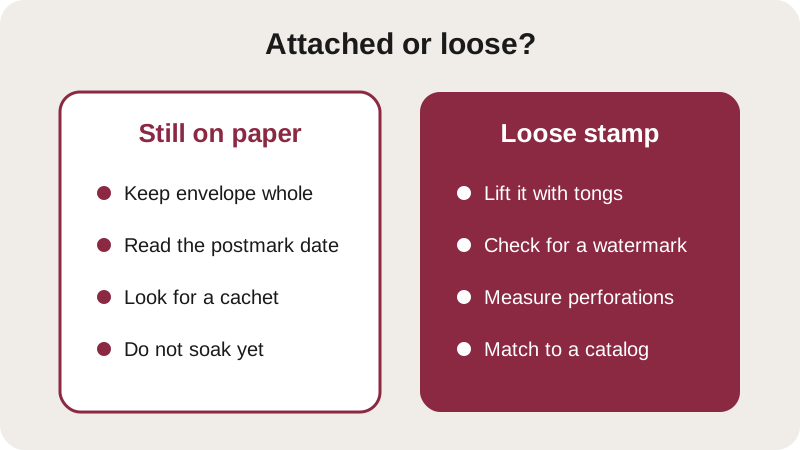
Knowing which pile an item belongs to tells you what to check first. A first day cover is identified mainly by its postmark date and cachet, while a loose stamp is identified by design, color, and perforation.
What tools do I need before I start identifying anything?
You do not need professional equipment to identify most items in an inherited collection. A small, inexpensive kit covers almost every case you will run into.
- Stamp tongs: for picking up and moving loose stamps without touching the paper
- Magnifier: for reading fine printing, checking for repairs, and comparing design details against a catalog photo
- Perforation gauge: for measuring the teeth along the edge of a stamp, usually counted across 2 centimetres
- Watermark tray or UV lamp: for revealing a watermark pressed into the paper during manufacture
- A catalog: Scott, Michel, and Stanley Gibbons each assign a unique reference number to every issue by country
If you are building this kit from scratch, a guide to using a stamp magnifier and one on using stamp tongs safely cover the basics in more depth than space allows here.
How do I identify each stamp or card step by step?
Once you have your tools and your sorted piles, identification becomes a repeatable process rather than guesswork.
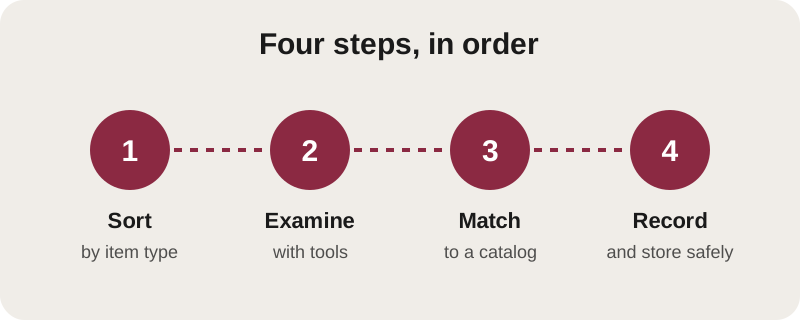
- Place the item on a clean, soft surface and handle it only with tongs.
- Note the obvious design clues: country name, language, portrait or scene, and currency printed on the face.
- Check for a watermark by placing the stamp face-down in a watermark tray, or pass a UV lamp over it for clues that are not visible in normal light.
- Measure the perforations across a 2 centimetre span with a gauge, and compare the measurement to catalog listings for that design.
- Look up the design, country, and year in Scott, Michel, or Stanley Gibbons to confirm the exact catalog number.
For stamps where the country is not obvious from the inscription, a visual approach helps. See identifying a stamp's country of origin for the design clues that narrow things down quickly, and the watermarks guide for how to read what you find in the tray.
How should I catalog and store what I identify?
Identification is only useful if you record it in a way you can find again later. A simple, consistent system beats an elaborate one you abandon after a week.
- Record the catalog number: note the Scott, Michel, or Stanley Gibbons number alongside country and year
- Note the condition: whether it is MNH (mint, never hinged), MH (mint, hinged), or used
- Mount it properly: use a stamp mount rather than a stamp hinge for mint material you want to keep unhinged
- Store loose items: a glassine envelope protects an unidentified stamp until you are ready to mount it
- Choose an album format: a stockbook suits large, unsorted quantities, while a hingeless album suits a finished, organized set
If you are deciding how to store the collection long term, the full storage and preservation guide covers album types, humidity, and handling in detail.
What if I still can't identify something?
Some items resist identification even with tools and a catalog in hand, especially damaged stamps, unusual overprints, or cards with illegible postmarks. That is normal, and it does not mean the item is unimportant.
Start with a broader identification guide to make sure you are reading the right clues in the right order; the general stamp identification guide walks through the same logic in more detail. A photo-based identifier can also help at this stage: the app identifies a stamp from a photo and suggests its country of origin, year of issue, and likely catalog number, which narrows your manual search considerably. For the stories behind unusual single items, background pieces like the one on the British Guiana 1c magenta show how far identification can go once you know what you are looking at.
If a term in a catalog listing or on a dealer's note is unfamiliar, the stamp collecting glossary defines the common vocabulary you will run into while working through an inherited collection. Once everything is sorted, examined, and recorded, you will have a clear picture of what the collection actually contains, which is the necessary step before any conversation about condition or next steps.
What's the first thing I should do with an inherited collection?
Before identifying anything, sort the material into broad piles: loose stamps, stamps still attached to envelopes or cards, and postcards. This stops you from mixing categories and makes it much easier to work through each pile methodically with the right tools and catalog.
Should I remove stamps from envelopes before identifying them?
Not right away. An envelope or postcard with a postmark and address often carries information you need for identification, such as the date and origin. Leave items attached until you have examined the whole piece, since removing a stamp can destroy evidence that helps date or place it.
How do I know which catalog number applies to a stamp?
Compare the design, color, and perforation against entries in a standard reference such as Scott, Michel, or Stanley Gibbons, which assign unique numbers to each issue. Country, year, and design details usually narrow the match quickly once you know which catalog to check.
What tools do I really need to get started?
A pair of stamp tongs, a magnifier, and a perforation gauge cover most identification work. A UV lamp helps with certain papers and watermarks. None of these require special training, and all of them protect the items from the damage bare fingers can cause.
Can an app help me identify cards from an inherited collection?
Yes, for the stamps themselves. A photo-based identifier can suggest the country of origin, year of issue, and likely catalog number, which narrows your research considerably before you confirm the match against a printed catalog by hand.