An e stamp barcode scanner can't identify a collectible stamp because barcodes carry postal tracking data rather than catalogue information, so identification has to come from the stamp's visible design, country, watermark, and perforations instead.
Published
Quick answer
An e stamp barcode scanner can't identify a collectible stamp, because barcodes carry postal tracking data, not catalogue information. Identify a stamp instead by its design, country, and watermark against Scott, Michel, or Stanley Gibbons numbers.
Key takeaways
- Barcodes on modern stamps carry postal tracking data, not catalogue identification.
- Most collectible stamps, especially vintage issues, have no barcode at all.
- Identify a stamp by design, country, watermark, and perforation, then match it to a Scott, Michel, or Stanley Gibbons number.
- QR codes on some new commemoratives link to extra content, not cataloguing data.
- A photo-based identifier works where a barcode scanner can't.
An e stamp barcode scanner can't identify a collectible postage stamp, because the barcode printed on a modern stamp or postage label carries tracking or payment data, not catalogue information.
What is the barcode on a modern stamp actually for?
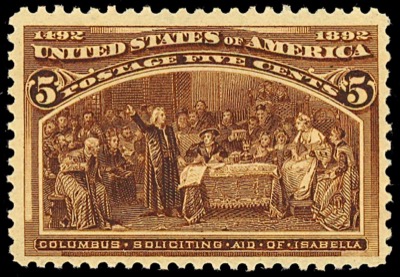
Most stamps in a typical collection have no barcode on them at all. A classic definitive, a mid-century commemorative, or a Victorian colonial issue was printed with a design, a country name or inscription, a denomination, and sometimes a watermark — nothing else.
Barcodes started appearing on stamps and postage labels as postal services automated sorting and introduced print-your-own and personalised postage. This is common on self-adhesive printed postage, parcel labels, and some newer digital postage formats bought online. The strip of lines or the small square code on these labels tells a sorting machine which class of service was paid for and where the item is headed. It is not connected to the stamp's design, its country of issue, or any entry in a catalogue, and none of it was designed with collectors in mind. Scanning it with a generic barcode reader, if the code even decodes, returns nothing a collector can use.
Can a barcode scanner identify a collectible stamp?
No. A barcode or QR scanner only decodes whatever data was encoded into that specific symbol — it has no connection to any catalogue of stamp designs, and the great majority of collectible stamps were never issued with a barcode in the first place.
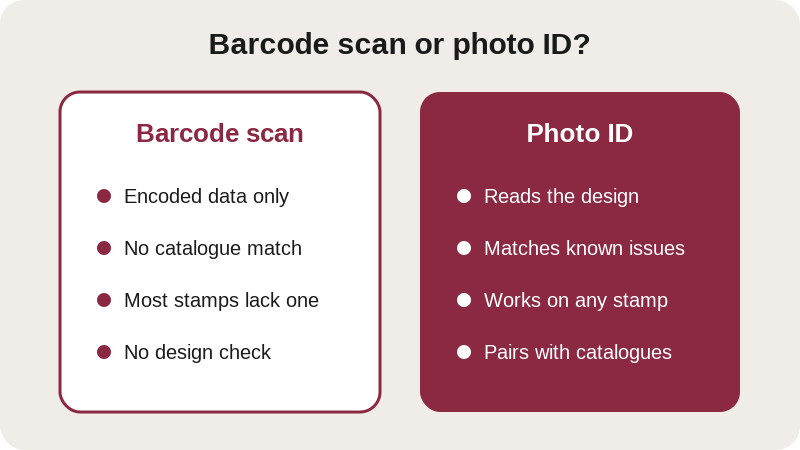
Identification in philately runs the opposite direction: you start from what you can actually see — the country name or inscription, the denomination, the main design, the colour, the perforation, and the watermark — and match those features against a catalogue entry. A barcode can only be as useful as the system that issued it, and no postal barcode was ever built to point back into a philatelic catalogue. That is true whether you are sorting a box of mixed world stamps or checking whether a single stamp is a scarce printing of a common design.
How do you identify a stamp without a barcode?
Work from the visible evidence instead of hoping a scan will do the job for you. The same handful of checks apply to almost any stamp, old or modern.
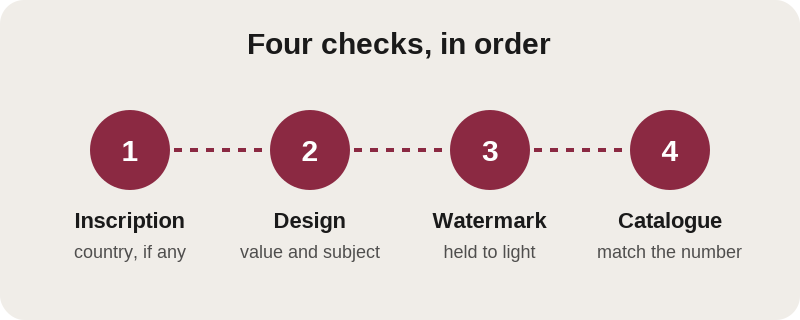
- Read the inscription. The country name, or its absence, narrows things down immediately — some of the earliest issuing countries never printed a country name at all.
- Note the denomination and design. Write down the face value and the main subject; this alone is usually enough to find the right page in a catalogue.
- Check the watermark. Hold the stamp face-down over a dark surface, or use watermark fluid, to see whether a watermark is present and what pattern it shows.
- Measure the perforations. A perforation gauge counts the teeth across 2 centimetres of the edge, and this measurement alone can separate two otherwise identical-looking printings.
- Match a catalogue number. Once you have the country, design, watermark, and perforation, look up the Scott, Michel, or Stanley Gibbons number that fits all four.
A photo-based identifier works much closer to how a specialist actually operates than any barcode scanner does: it compares the visible design against a reference set of known issues, rather than trying to decode a symbol that was never printed on the stamp to begin with. It can suggest likely catalogue matches even on a stamp with no readable text at all, simply from the shapes and colours of the design. The stamp identification guide walks through the full visual checklist, and the postage stamp scanner lets you photograph a stamp directly instead of searching for a barcode that isn't there.
What about QR codes on new commemorative stamps?
Some recent commemorative issues add a small QR code alongside the printed design, usually linking to a video, a web page, or background information about the subject shown. That code is a feature of the specific stamp, not a universal lookup tool — scanning it will not return a Scott or Michel number, and it only works for that one issue for as long as the link stays live. Some issuing authorities also use similar codes for anti-counterfeiting checks on high-value definitives, but that still has nothing to do with looking up a catalogue number.
Treat a QR-coded commemorative the same way you would treat any other modern stamp: identify it from its design and inscription first, and treat the code as an added extra rather than a shortcut to cataloguing it.
How do you catalogue and store a stamp once you've identified it?
Once you know what a stamp actually is, write it down rather than relying on memory. Record the catalogue number, the condition, and where it sits in your collection.
- Record the catalogue number from Scott, Michel, or Stanley Gibbons, so you or anyone else handling the collection later can find it again instantly.
- Grade the condition honestly. Centering, gum condition — whether it is MNH or MH — and any faults all belong in the description. The condition grading guide covers the full scale.
- Store it properly in a stockbook, a hingeless album, or an individual glassine envelope, and lift it with stamp tongs rather than fingers. The storage and preservation guide covers mounts, hinges, and long-term care.
- Check under a UV lamp from time to time for repairs or alterations that are not visible in normal light, especially on anything bought secondhand.
None of that depends on a barcode. A scanner, barcode or otherwise, can only read what was printed on purpose. Identifying a stamp depends on correctly reading everything else — the design, the paper, the watermark, and the perforations — which is the one step no scanner can skip for you.
Do collectible postage stamps have barcodes?
Almost never. Barcodes mainly appear on recent self-adhesive postage labels, print-your-own postage, and parcel stickers, where a sorting machine needs to read payment and routing data. Classic and mid-century stamps, and most modern commemoratives, carry no barcode at all — they are identified by their printed design instead.
What does the barcode on a modern stamp or label actually mean?
It encodes postal information such as the service paid for and the destination, read by sorting equipment. It has no link to a catalogue number, country listing, or design reference, so decoding it tells you nothing about the stamp's place in a Scott, Michel, or Stanley Gibbons catalogue.
Can a barcode scanner app give me a stamp's catalogue number?
No. A barcode scanner only reads the specific data encoded in that symbol; it cannot search a philatelic catalogue. To find a catalogue number, compare the stamp's country, design, denomination, watermark, and perforation against catalogue listings, or use a photo-based identification tool instead.
My stamp has a QR code instead of a barcode — does that help identify it?
Usually not for cataloguing. QR codes on recent commemoratives typically link to a video or web page about the subject, not to catalogue data. Identify the stamp from its printed design and inscription first, and treat the QR code as extra content rather than an identification shortcut.
How do I identify a stamp that has no barcode at all?
Work from what is printed on the stamp: the country name or inscription, the denomination, the design, the colour, the watermark, and the perforation measurement. Match those details against a Scott, Michel, or Stanley Gibbons listing, or photograph the stamp with an identification tool to narrow it down quickly.